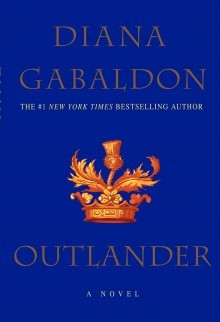
 Title: Outlander (Outlander #1)
Author: Diana Gabaldon
Publisher: Seal Books
Published: January 1, 1991
Number of Pages: 870
Genre(s): Science Fiction, Romance, Historical Fiction
Date Read: February 2006 (The 1st time...)
Acquired: Chapters
Title: Outlander (Outlander #1)
Author: Diana Gabaldon
Publisher: Seal Books
Published: January 1, 1991
Number of Pages: 870
Genre(s): Science Fiction, Romance, Historical Fiction
Date Read: February 2006 (The 1st time...)
Acquired: Chapters
Summary:
The year is 1945, the Second World War has just ended and combat nurse Claire is finally reunited with her husband, historian and amateur genealogist (and former Army Officer) Frank Randall. They seek bliss and rest in the highlands of Inverness, Scotland so that Frank can do some family research on a descendant who was an Officer in the area back in the 1740s, before the start of his tenure as a History Professor at Oxford. Young and innocent they think they have the entire future together ahead of them, until curious Claire, unversed in the mysterious mythology of the standing stones of Scotland, goes exploring alone and disappears.
Claire suddenly finds herself transported back through time, about 200 years back, because that's how all the legends go, to 1743, a dangerous time to be a British lady in the Scottish wilds where the border clans are at war with each other and with the British. As dangerous a place to be as the war she just finished surviving in 1945. She's confused, she's lost, she's alone...at least until she's picked up by a band of MacKenzie warriors on the run from the local British army regiment who save her from the Captain of said regiment, one Jack Randall... They take her in, believing her to be a British spy, and bring her to their laird for judgement. When he decides she's not an immediate threat they offer her protection, protection in the form of an arranged marriage to the young outlaw nephew of the laird, one Jamie Fraser, who Claire hasn't been able to keep her eyes off of since the moment she met him. She doesn't love him, she doesn't want to but she needs him.
They begin their life together with Claire torn between her new reality and the reality she left behind, and a desire to return there. Things are going along as peacefully as one would expect from a war torn Scottish nation in the 1740s, until Captain Jack comes back into the picture. He seems to have a grudge against both Claire and Jamie, something that seems very personal. Can Claire learn to love Jamie? Can they come together enough to survive Black Jack? Or will she flee from Jamie the first chance she gets to try and get back to Frank?
Review:
I would like to start this review by saying, I like to consider this book as a stand-alone book and I would have been perfectly content to never have found out it was a series. I tried reading the second book and I just got very turned off by the willy-nilly back and forth of the characters travelling through times to multiple periods multiple times. I am very critical of time travel because it is really really hard to get right in a way that does not create glaring plot holes. I can pick out plot holes anywhere but present me with a time travel plot and I will find even a pin head sized plot hole that I then use to unravel the entire story, I've done it on several occasions thoroughly annoying people who genuinely enjoyed the story and never questioned the integrity of the plot. Just wanted to clear that up and let you all know why this review will make no reference to the rest of the series.
Back in 2006 I never would have willingly picked up a romance novel, not even if you paid me, and yet I actually paid hundreds of dollars for the privilege of reading this book, because I had to read it for an undergraduate English class. I will not lie, I have gotten out of required course readings I didn't think I would enjoy through various means in the past; like the time I didn't even crack the spine on The Tempest I just based all my answers about the play on a combination of the very, very strange 3 man production of it I saw at The Globe, and Spark Notes. I was sorely tempted to do that with this book given the reading load I was faced with that particular semester and my distaste for romance novels. That was before I actually read the summary on the back, the minute I read the summary I had two thoughts, "Oh dear god time travel I am going to hate this even more than I would have if it was just a normal romance novel!" and "Ooooh 1700s Scottish Highlands! Swords and red heads, okay I'm done this book is getting read." Yup you tell me there will be sword play and I will read it, you tell me there will be sword play AND red heads (I have a thing for red heads in a big way, it has been known to lead to me embarrassing myself horribly...) and there's no way I won't read the book. It was actually about this time in 2006 that I read it because I spent my entire reading week glued to it, so that makes this week the 7th anniversary of me reading it for the first time, and since then I've read it about 10-12 more times, so that right there should tell you just how much I liked it.
I not only liked it, I loved it. With the exception of the first 39 pages. I was okay with those first 39 pages the first time I read it, but after finishing it the first time I'm not a big fan of Frank and just really don't want to read the part that he's in, so on most of the times I've re-read it I've started on the second half of page 39 and read from there.Did anyone else who has read it feel that way? Am I the only one here? For me the book really gets started in chapter 3, that's where Claire finds herself transported back to the 1700s and the fish out of water story really gets started. I'm so glad Diana gave Claire the characterisation that she did, because Claire's stoicism, strength, stubbornness and adaptability are what drive this story for me. If Claire had been the stereotypical romance heroine that I dreaded she would be when I heard I was going to have to read a romance novel I would have been crushed, but watching Claire grow into the role of a 1700s Scottish lady was nothing short of magical, by the end of the book I at least felt like Claire really belonged exactly where she was and I actually couldn't picture how she would fit into the WWII era world she had come from.
Obviously I have to talk about her relationship with Jamie, the Hero of the novel, who numbers among my favourite literary red heads, can't really leave discussion of that relationship out. Diana's writing in this book is exquisite in my opinion, but I especially enjoyed her portrayal of the central romance in this couple, it was very realistically done. You have a heroine who is a "modern" woman coming back to the 1740s so of course there are going to be culture clashes, especially in the area of romance, and the clashes between Claire and Jamie are SPECTACULAR. Seemingly horrific, for obvious reasons, as Claire points out corporeal punishment is barbaric now a days (and even in 1945), but it was normal to Jamie, and honestly the way Diana handled the writing of it it comes across as more hilarious than horrific. For every moment of them blowing up at one another there are as many or more moment where you can just watch them slowly realise how much they love one another and that they really are quite well matched to one another in both personality and nature. Jamie is an impulsive, injury prone warrior and Claire is a responsible (usually), calm former combat nurse; which means that in the eyes of the Scots of the 1740s she's the best surgeon/doctor in existence. That becomes a bit of a running gag between the two.
There are sex scenes, of course, it's a romance novel that's a given, but you don't read this novel for the sex scenes, or even just for the romance. There is an actual discernible and complex plot in this novel and it's just as important if not more important than Jamie and Claire's relationship, if only because of how intertwined the villain is to both Claire and Jamie as individuals and as a couple.
Since I'm being honest, I feel completely comfortable saying that in my opinion, this is one of the best and most well thought out and written books that I have ever read. And I have no doubt that I'll probably read it another 10-12 times in the next 7 years. Ask me again in 7 years and we'll see!
--Ren
Title: The Taker (Book One of The Taker Trilogy)
Author: Alma Katsu
Publisher: Gallery Books
Published: September 6, 2011
Number of Pages: 464
Genre(s): Paranormal Romance, Urban Fantasy, Historical Romance
Date Read: February 1, 2012
Acquired: Wal-Mart
Summary:
Luke is working what starts off as a quiet night shift in the ER of a small town Hospital in rural Maine. That quiet relaxing shift ends when the Deputy shows up with a murderess; an ethereal waif with a mass of blonde curls, slight, beautiful, and covered in blood. Luke is immediately and inexplicable intrigued by this girl, but not because she is a murderer, he can't pinpoint why, and then she starts to tell him her story. The story starts with an admission that, yes, she did kill her companion, but it wasn't murder, he had asked her to do it. He being Jonathan St. Andrew, Luke doesn't believe that it is a coincidence that the man shared his name with the town they are in.
Lanny, that's the name of the beautiful killer, convinces Luke to help her escape the hospital by beguiling him with her sordid tale. With her story she takes him back over 200 years, to her birth and early life with Jonathan as the children of the founding generation of St. Andrew, Maine. How she loved him all of her life, and he never loved her back; the multitude of ways they hurt each other until she was sent to Boston. In Boston Lanny finds herself ensnared by a hedonistic group led by a charming, sado-masochistic, madman who falls in lust with Lanny's beauty and capacity for "perfect love". As they run for the Maine-Quebec border crossing Lanny's story changes to Lanny's story about this man, Adair's story, and from then on the three tales are interwoven. Lanny is trapped with Adair, forced to entrap Jonathan; has she trapped Luke the same way 200 years later after killing Jonathan?
Review:
What drew me to this book first was the striking cover; every time I went into the store it sat there on the shelf calling to me. Finally I caved and picked it up to read the summary on the back. My first thought was "Oh another vampire novel, sounds interesting enough." and with that it was promptly put into the cart and brought home. Where it then sat on the pile for a month or so calling to me as I read other books. I was in the process of trying to read The Thirteen Hallows, but I was having trouble keeping engaged, and I realised the reason was that I REALLY wanted to be reading The Taker, so I gave in and put the Hallows on hold to take it up.
To be honest I wasn't entirely sure how I felt about it as I started reading it, and that uncertainty stayed with me for most of the books. Be warned that this is actually a very dark book, with quite a few morbid parts. It markets itself as a romance, a love story, but I really don't like those labels for this. None of the love in this book is healthy in any way, shape or form. You've got Lanny's obsessive love for a self-centred, arrogant golden boy who takes her for granted and strings her along for her entire life; KNOWS that he is doing it BUT STILL CONTINUES to do because she's his only friend. Then you've got Jonathan, the aforementioned golden boy who claims to love Lanny, but not enough to actually rectify the way he treats her. Adair claims to love Lanny, but I feel like he is completely amoral and incapable of love, he feels covetous of her beauty and her capacity to love, he doesn't love her but he desires her and wants to posses her. She in turn sort of falls for him for a time in what screams to me a clear cut case of Stockholm Syndrome until she rationalises herself out of it. And then there's Luke, who toward the end of the novel fancies himself in love with Lanny, even though he's only known her for a few months and most of the things he knows about her tell her that she's not exactly the delicate damsel in distress she appears to be.She needs him, and he needs her, but again I can't see anything healthy in their relationship and I definitely can't see the type of love that warrants giving this novel the label of romance. The interplay in these relationships is complex and intriguing, definitely keeps you thinking, I just really dislike it when a book tries to present itself as something it is so clearly not.
That all being said it did deliver as promised by the advanced review on the back, even if it couldn't be honest with itself, you can always count on a reviewer to point out the truth, it's a showcase of the dark side of romantic love; that is a statement I can agree with. I don't have any personal experience with the dark side of love, thankfully, but I feel safe in saying that Katsu's relationships in this novel definitely have crossed the boundary into that realm.
I think it's a bit of a breath of fresh air in that regard. Yes it's dark and twisty (like Meredith Grey always claimed to be!) and I frequently found myself highly disturbed by the fact that I was enjoying the book. Because of the content of the book I keep finding myself saying out loud, "I'm not entirely sure if it's all right to find this interesting or not..." and then I'd have to set the book down and walk away from it for awhile and work through what I'd just read in my head. With the exception of Luke none of the main characters deserve sympathy from the reader, Lanny comes close because of the circumstances and context surrounding her behaviour, but for the most part it's really hard to give her sympathy. What Katsu did amazingly well here was to create characters so utterly undeserving of sympathy that you can't actually help but feel sorry for at certain times and then that leaves you shouting "ACK NO S/HE'S AN ARSE I SHOULD NOT BE FEELING SORRY FOR THEM!!" and banging your head against the desk...or maybe that's just me, I have a tendency to get REALLY into whatever I'm reading...
How do you feel when you find yourself feeling sympathy for a character who you know doesn't deserve it?
--Ren
 Title: Death Has Come Up Into Our Windows
(The Zombie Bible Book #1)
Author: Stant Litore
Publisher: 47North
Published: August 14, 2012
Number of Pages: 93
Genre(s): Horror, Historical Fiction, Mythology
Date Read: January 13, 2013
Acquired: Chapters
Title: Death Has Come Up Into Our Windows
(The Zombie Bible Book #1)
Author: Stant Litore
Publisher: 47North
Published: August 14, 2012
Number of Pages: 93
Genre(s): Horror, Historical Fiction, Mythology
Date Read: January 13, 2013
Acquired: Chapters
Summary:
Yerusalem is being ravaged by a plague, so what else is new? It's biblical times, something bad is always happening in Yerusalem! This isn't just your normal plague though, this isn't wine and water turning to blood, it's not frogs or fireballs falling from the sky, and it's definitely not something as mundane as a plague of locusts. No, this is an old plague, true evil, a sign that the people of Yerusalem have truly failed God and are doomed, it must be; for why else would the dead be walking the earth?
Yirmiyahu (Jeremiah for those of you unfamiliar with the biblical spelling) tried to warn the people, he truly did. He tried to stop them, did everything in his power to try and make them see the error of their ways. He has failed; the city is besieged by Babylon and there are more and more dead wandering the streets, soon they will surely out number the living. He is of course terrified and appalled, with his fellow men and especially with himself. He blames himself for their downfall, for not doing even more than he did to stop it from coming to this. Yirmiyahu has given everything to try and save Yerusalem, even breaking his covenant with his wife to send her away so that he could stay and try to save the city he loves. But now he is alone, for even God has left Yirmiyahu.
WIthout God how can Yirmiyahu hope to save Yerusalem and its people from the tide of walking dead that they unleashed upon themselves?
Review:
At 93 pages this is a lovely little one sitting read, or at least it would have been something I could have read in one sitting were it not for the fact that I've been having a hard time concentrating on anything for more than thirty minutes at a time thanks to my wisdom tooth headaches (I'm headed to the dentist on Wednesday to get that looked at). I like books that can be read in one sitting, I'd much rather spend two and a half hours reading a book from start to finish than watching a movie. The book is a much richer world and I have a very vivid imagination; I usually much prefer my own visualisations to those in film adaptations for example. Because of my headaches, I wanted something that would allow me to get through it quickly because I knew it would be an effort to focus so I scoured the pile and came away with this and it fit my reading needs at the time perfectly.
This is not the type of book I would normally gravitate towards, when it comes to supernatural creatures I'm usually a vampire or werewolf fan. I always used find zombies to be incredibly lame but then I took a class back in 2008 and we studied zombie movies and even though I still thought they were lame I enjoyed the symbolism of them. Milla Jovovich and the Resident Evil series can be attributed with eradicating my dislike of zombies; the zombies in that series are not lame at all. So thanks to that class, and Resident Evil when I won the third book in the Zombie Bible series from Book Riot's Name that Author contest one week back in November I was super excited to read it because a) Hey I won a free book! Yeah! and b) Oooh Christian mythology meets modern horror! so I decided then and there that I would acquire the first two books and read them in order. I asked my local library to order them, and they did; but then I ended up getting a lot of book money for Christmas and just bought them myself.
I'm extremely glad that I did decide to dive in and give the zombie lit. a chance because this book didn't disappoint me. That being said, if you're a zombie fan a word of warning, do not be fooled by the gory cover image above, the title or the summary; the zombies are in there, assuredly, but they are not the stars of the action so if you're expecting gory action scenes all over the place and life or death chases this is not the zombie book you are looking for. I for one am okay with that because I really enjoyed the direction that the author took the story but maybe that's just the religious culture scholar in me? There's a lot of philosophical and religious waxing on the part of the main character; a good 90% of the book is him working through his own actions and those of his fellow Israelites, trying to figure out if they are capable or even worthy of redemption by God. For that reason the narrative is not linear it jumps around a lot between the present and several different points in the past through flashbacks.
On the plus side you really don't need to know anything at all about Christian mythology because Litore has taken little almost meaningless biblical incidents and imbued them with a new fantastical life. It is a bold undertaking indeed, and I know that there are people out there who are perfectly willing and ready to label this as sacrilege or blasphemy, but I am not one of those people. I applaud him for having the courage to take on this idea and it is a brilliant one. He has executed his vision amazingly, and he is so completely into this project that even his historian's note at the beginning and about the author section at the back do not break from the character he has created for himself of a zombie historian who has survived a 1992 outbreak of zombies in the Pacific Northwest. That right there is dedication to one's art.
I am excited to read the rest of the series and Stant Litore is now most definitely on my list of authors to watch for.
Check him and his zombies out at http://zombiebible.blogspot.com
--Ren


